

Chronic pain
Do you have chronic pain?
Read below for advice about the warning signs of chronic pain.
Chronic pain is longstanding pain that has persisted for more than three months. If you suffer from this, then you may find the following helpful. The following information is based on the Understanding Pain Programme in cooperation with the Oxford University Back Skills Training (BeST).
Understanding pain
Read information about understanding chronic pain
In the early (acute) stages post-injury, pain can be useful to warn us of tissue damage. However, pain isn't always an accurate indicator of the amount of tissue damage that has taken place. For example, soldiers may not realise the extent of their injuries until they have left the battlefield. Conversely, a stubbed toe may feel severe, but be fairly harmless.
This is even more true if pain has persisted for more than three months (i.e. become 'chronic pain'), by which time most of the healing will have taken place.
Long-term pain
Pain persists due to:
changes in the nerves which carry messages about pain to the brain
nerves becoming hypersensitive, so even light touch is interpreted as pain
our brain causing us to feel pain when we produce a previously painful movement, based on it's memory of pain

Pain and the brain
Read more about how pain can be recognised by the brain.
Your brain contains a map representing the body. This map can change as a result of experience. For example, a professional violinist’s hands will appear larger, meaning that the brain pays greater attention to them.
In chronic pain, the painful area can become larger in the brain and can even take over other areas of the body map, meaning that movement from other body parts can now also result in pain. The messages the brain receives from the tissues do not say “pain”, but instead, our brain receives these messages and decides whether pain is an appropriate response.
Retrain our brain system
Read below how to retrain your brain to improve pain management.
All of these changes are reversible, we just need to retrain our pain system. How to do this is explained in the sections below.
Being stiff or weak directly influences how much activity we do, by making it harder to be active. Having weak muscles and stiff joints will increase pain. However, this is also two-way, as pain can directly inhibit muscle activity.
When starting or progressing an exercise, you are likely to feel normal aches/pains due to exercise, which are not associated with harm. Doing any physical activity is better than doing none.
The pain cycle involves a continuous cycle of pain with 3 main elements contributing to each other, including:
- persistent pain: over-sensitised pain system
- altered activity: doing less due to pain
- physical changes: developing weaker muscles and reduced fitness
Usually, when you are in pain or having a ‘bad day’, activity levels reduce. Conversely, when you are having less pain or a ‘good day’, activity levels increase (catching up). However, increased activity on better days can often flare up pain, leading to decreased activity the next day.
This way of managing our activity levels reinforces the link between activity and pain, leading us to avoid more and more in an attempt to get control over the pain.
In general, we see that the overactive or underactive cycle leads to a gradual decline in activity levels. Therefore, trying to avoid these peaks and troughs is likely to be helpful. This is called pacing.
Pacing means balancing activity so that the day is divided into periods of relative rest and activity. It can gradually build on what you can presently comfortably achieve, limit overactivity and help you manage the day better by keeping to your planned target.
Pacing also means doing the activity, whether feeling good or bad, not doing too much or too little. The aim is to maintain an even level of activity over the day and week.
On a good day, you should not wait for the pain to tell you when to stop, but instead you should stick carefully to your plan and avoid overdoing things. On a bad day, you should still try to keep going as planned, but you could break up activities more to make it more manageable.
Example: Cleaning the car
- Prioritise – What must be immediate and what can wait until another time? Dust inside the car and clear out the rubbish because you are giving someone a lift later.
- Plan – Plan activities and think about what order to do things in. Try hoovering the back of the car one day and the front another day.
- Tolerance level – Work out your baseline for each activity to try and find the middle ground between what you would do on a good day and what you would do on a bad day.
- Evaluate – Stick to the plan and re-evaluate after several days. If no problems with dusting and emptying the car of rubbish, next time try hoovering the back seats as well and see how it feels.
Whatever activity you are planning, it is important to work out where to start.
For example, walking:
- Choose the best time of day to walk and select a good place to start.
- Walk at your own pace for a sensible period that you feel you can manage.
- Record the time or distance walked, for example, 15 minutes.
- Repeat again another day and record the time or distance, for example, 20 minutes.
- Repeat again on a third day and record the time or distance, for example, 10 minutes.
- Your baseline should be slightly below your average (approximately 80%, so multiply by 0.8).
- Calculate the average (add scores together and divide by three) for example, 15 minutes.
You can find your baseline by:
1. choosing the activity you want your baseline for
2. completing your activity and recording the amount of time or distance that you can do the activity for
3. doing the same activity again the next day and on the third day
4. calculating your average
This is called ‘graded activity’ and represents an incremental approach to allow physical conditioning to occur. If we have an increase in pain after making a graded increase, we should go back to previous level for a little while longer, or drop down even further, so the increase isn’t quite as much.
Goal setting
A goal should be:
- achievable
- in a set timescale
- written down
- meaningful
- realistic
- broken down into small achievable steps
- rewarded when achieved
If you don’t achieve your goal, learn from this, break the goal down into smaller steps and measure your baseline again.
Specific – “being able to walk to the local post office and back”
Measurable – be able to monitor progress
Applicable – something you want to do and will improve your quality of life
Rewarding – this will help with motivation
Timed – ‘when’ is it expected the goals will be achieved (short and long term)
When we are faced with a task or a situation, it is the thoughts we have about the task that produce emotions or feelings, which determine how we act.
The unhelpful thoughts cycle involves:
- Thoughts - creating feelings
- Feelings - creating behaviours
- Behaviours - reinforcing thoughts
This depends upon our own previous experiences or what we have learned from others.
Unhelpful thoughts impact our actions and outputs/behaviours. Challenging these thoughts can help to change our approach to activities.
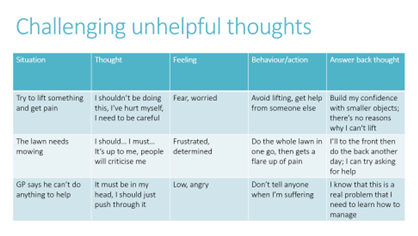
Unhelpful thoughts and feelings can influence all parts of the ongoing pain cycle. Persistent pain, altered activity and physical changes to the body can all contribute to unhelpful thoughts, and unhelpful thoughts can also trigger the pain cycle.
When we’re in pain, we tense up. Tense muscles, in turn, can become uncomfortable or painful. Relaxation techniques help us to relax these muscles, as well as counteract the side effects of stress. Relaxation can help reduce chronic pain, anxiety, high blood pressure and cholesterol levels.
The best relaxation techniques are those that can be done anytime, anywhere and in any position.
Example: If you were stuck in traffic and could feel your muscles tensing, then you would need to be able to start relaxation techniques while sitting.
The key to succeeding with relaxation techniques is to practice them initially when pain is at a tolerable level, so that when the pain is worse, you know the routine and the techniques can be more effective.
Lots of different things can impact how much pain you feel.
Example: Have you ever noticed that we sometimes seem to notice a clock ticking more loudly? The ticking hasn’t got louder or quieter, even though it seems louder or quieter.
This is similar to being more aware of your pain at night when it's quiet, dark, and there is nothing much else to think about. The ticking also gets louder when we are worried about the time, which would also relate to pain if you are worried about it. Actions reinforce the thoughts that cause the vicious cycle. We can break this cycle through things like distraction.
Flare-ups are expected as this is the nature of persistent pain. The trick is to have plans for managing the good and the bad spells.
An effective plan for a good spell:
- progress exercises and goals
- add new goals
- reduce medications
- enjoy yourself
- plan ahead
- stay active
- practice relaxation
An effective plan for a bad spell or flare-up:
- carry on
- review baseline
- review medication
- set goals
- relaxation
- allow personal time
- if possible, identify triggers, learn from them and plan for the next time. However, often there is no clear cause
Need more help?
Consider self referring using the link below:
If you have a new injury or problem, please look at the self help information in our advice pages. We will often complete the same exercises and share information in clinic appointments.
If you still need some more help you can self refer into our service. Please note that the NHS is currently experiencing longer than normal waits, for more information visit our waiting times page.