
Hip pain
Understanding hip pain
Hip pain can be caused by age related changes, a fall, an injury or through repetitive activities. As one of the largest joints in the body, injuries to the hip joint can result in significant limitations to your mobility and day to day activities.
Depending on the condition that’s causing your hip pain, you might feel the discomfort in your:
- thigh
- inside or outside of the hip joint
- groin
- bottom
Sometimes pain from other areas of the body, such as the back or groin can radiate to the hip.
It's important to keep joints moving, even when you're dealing with pain from age related changes or an overuse injury.
Speak to your GP if:
your hip pain came on following a fall or trauma
you are unable to weight bear through your affected leg
About the hip
The hip is a ball and socket joint that allows movement and provides the stability needed to bear weight. It relies heavily on the necessary strength of the surrounding muscles. The socket sits within the pelvic bone and the ‘ball’ is at the top of the thigh.
Common causes of hip pain
The hip is one of the joints most commonly affected by osteoarthritis, particularly if you are over the age of 50.
Osteoarthritis is a condition that affects the joints and can cause pain and stiffness. Our joints go through a normal cycle of wear and repair during our lifetime. During the repair phase, the joints may change in structure and shape, causing thinning of the cartilage between the joint surfaces. Read more about osteoarthritis.
Pain from the hip joint is typically felt in the groin and sometimes can be felt from the top of the thigh to the knee and occasionally all the way down to the ankle. It might feel worse with specific movements like prolonged standing, walking, twisting and bending.
The lumbar spine (low back) can also refer pain into these areas and therefore if symptoms are worsening despite the advice and exercises given below, further assessment by a health care professional is recommended.
Typical physical signs of osteoarthritis include:
- tenderness over the joint
- stiffness in the morning, but does not usually last more than 30 minutes
- creaking of the joint
- joint swelling
- restricted movement
- decreased joint stability
- weakness of thigh muscles
Whatever the cause, exercise and following our simple tips can help reduce the symptoms.
Top tips for managing hip osteoarthritis
Read our top tips about managing hip osteoarthritis
- Keep active but pace yourself. Don’t overdo it on ‘good’ days and keep moving on ‘bad’ days. Alter your activities depending on your pain.
- Try to maintain a healthy weight, as it reduces excessive load on the hip and improves function.
- Wear shoes with thick, shock-absorbing soles to cushion the impact of walking.
- Ensure you take regular pain killers as advised by your GP to help with effective pain relief and to aid increased function.
- Apply a heat or ice pack to ease pain and stiffness. Ensure you protect your skin to avoid burns or irritation. Do not use ice if you have poor sensation over the area, an infected wound, Raynauds Syndrome, or Cryoglobulinaemia. A TENS machine can also be used for pain relief and reduction of stiffness.
- Don’t stay in the same position for long periods of time, for example, sitting or lying. When you are awake, move your hip gently for 10 to 20 seconds every hour. If you are struggling to walk and need assistance, walking aids can be provided by the NHS. If you wish to purchase your own, please seek assistance in measuring to ensure the right fit.
Hip exercises
Read below for advice and exercises to manage hip pain. This guidance has been produced by the Dynamic Health physiotherapy service. It offers simple measures to help you manage your hip problem safely. Often the right advice and exercises are all you need to improve the problem.
This information has been made available to your GP, who may ask you to try the advice and exercises prior to consulting a physiotherapist.
If your hip pain started suddenly after a recent significant injury, for example, a slip, trip or fall, and you are unable to weight-bear, or if you have a hot, swollen hip with a high temperature and fever, please seek urgent medical advice from A&E, minor injuries or NHS 111.
How much exercise should I do?
Exercise every other day
Allowing enough rest is important to let soft tissues recover and develop.
Choose 3 or 4 exercises
Choose exercises that are challenging but manageable.
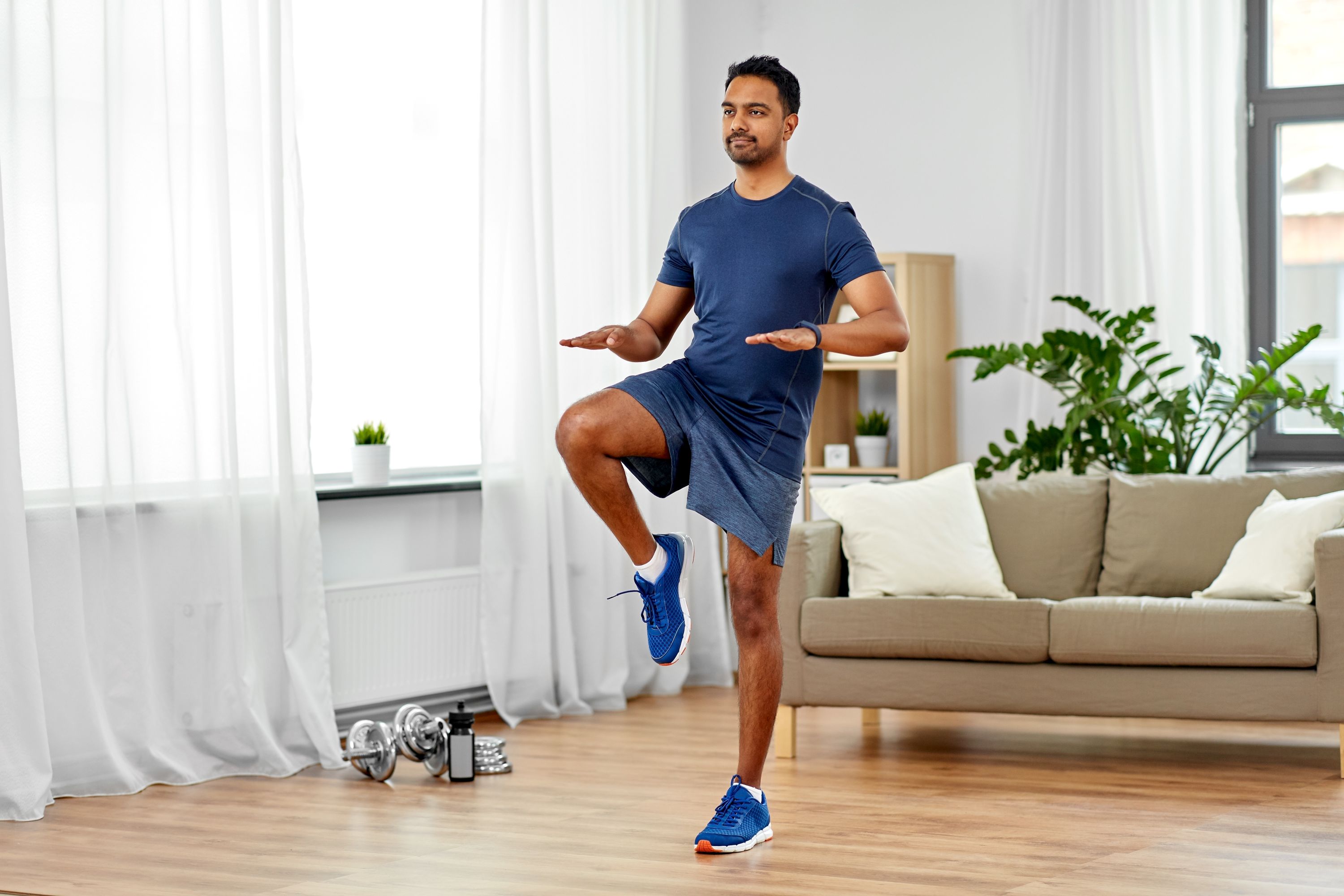
Repeat the exercise
Perform 5 to 10 repetitions of each exercise, 3 to 5 times a day.
Rest
Rest for up to 1 to 2 minutes between each set.
Once an exercise is easy, progress it
Increase the number of repetitions (you could aim to increase it by 2 to 5 repetitions every 2 weeks). Or hold the positions for longer or move to a more challenging exercise.

How much pain is too much pain?
Read below for advice and exercises to manage hip pain.
Before exercising
Before exercising, rate your pain at the moment on a scale of 0 to 10, where 0 is no pain and 10 is the worst pain you can imagine.
A maximum pain level
A maximum pain level of 4/10 whilst exercising is fine as long as it eases within 45 minutes of the session and does not interfere with sleep or activities the next day.
If your pain increases
If your pain increases beyond this, simplify the exercise by reducing the range of movement or number of repetitions, or try an easier exercise.
Osteoarthritis exercises
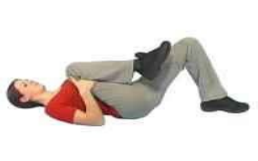
Lie with your knees bent and your feet on the floor.
Lift one knee towards your chest.
Place your hands behind the knee and draw it into your chest.
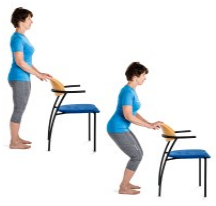
Stand and take support if needed.
Squat down and at the same time move your pelvis slightly backwards.
Straighten your hips and return to the starting position.
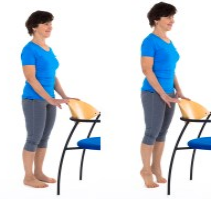
Stand tall, with your weight distributed evenly on both feet, and take support if needed.
Rise up onto your toes and in a controlled manner return to the starting position.
Low level exercises
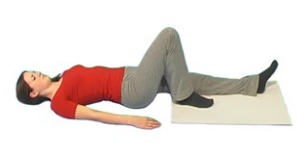
Lie with your knees bent and feet on the floor hip width apart.
Turn the soles of your feet to face each other and allow your knees to fall outwards.
Feel the stretch in your groin.
Keep your back flat on the floor during the exercise.
These can be done on your bed, you don't need to get on and off the floor if it is too difficult.
Lie on your back with a sliding board or plastic bag under your leg.
Bend and straighten your hip and knee by sliding your foot up and down the board.
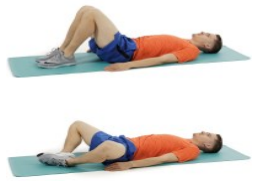
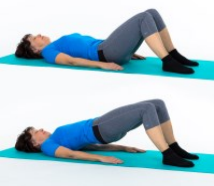
Lie on your back with legs bent.
Squeeze your bottom muscles and roll your pelvis off the floor.
In a controlled manner, return to the starting position.
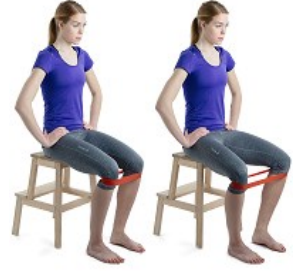
Start by sitting on a bench with feet flat on the floor and a mini band around your legs, close to your knees.
Keep your feet in place and move your knees outwards against the resistance.
Feel the tension in your bottom.
Slightly holding back the movement, bring the knees back to the starting position.
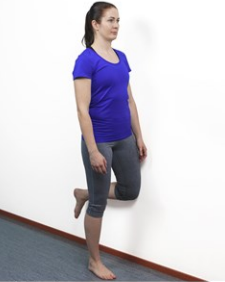
Stand tall, sideways close to a wall with one knee bent and supported against the wall.
Press the knee against the wall while keeping the hip, knee and 2nd toe of the leg you are standing on aligned. Don't let the knee of the leg you are standing on rotate inwards.
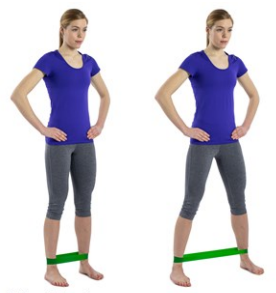
Start by standing with a mini band around both ankles or feet. Hips are straight, and knees are soft but not bent.
Take steps sideways against the resistance from the band. Feel the tension in your buttocks.
If this is too difficult side step without the band.
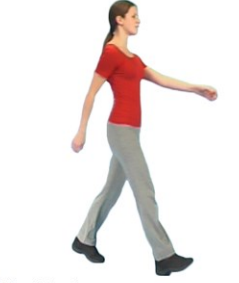
Start with short distances more frequently through the day and gradually increase time/distance as able.
High level exercises
Stand up tall with your back against a wall and hold onto a support as you need to.
Lift your leg sideways, keeping your leg against the wall and leading the movement with your heel.
Then bring your leg back to the start position.
Keep your upper body straight throughout the exercise.
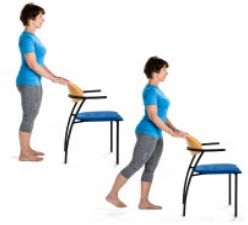
Stand tall holding onto a chair.
Squeeze your bottom and bring one leg back, keeping your knee straight.
Choose a good steady chair such as a dining room chair for this exercise.
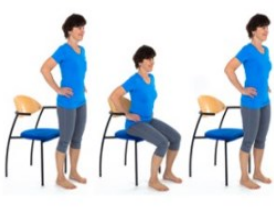
Sit on the chair with your feet and knees hip width apart and feet flat on the floor.
Aim to keep your knees and feet pointing forwards.
Stand up purposefully pushing through your heels, straightening your knees and tucking your hips underneath you to stand up tall.
Sit back down in a steady and controlled manner, leading with your hips as you simultaneously bend your knees and hips.
Throughout the exercise try to keep looking forwards. It can be helpful to pick something to focus on.
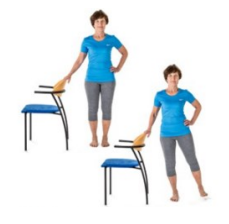
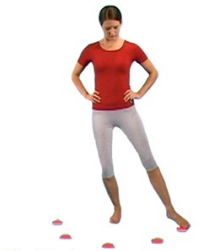
Lift your leg and point the foot to the side as shown in the image. Do not let your knees turn in or out during the exercise. Have a chair beside you if you need some support.
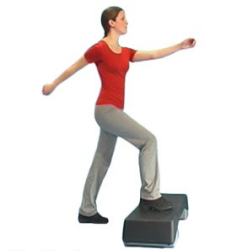
Stand in front of a 20 to 40cm step.
Step up 10 times with one leg leading and then repeat with the other leg leading.
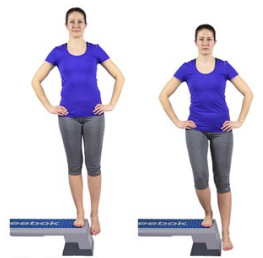
Stand on the edge of a step, with one leg hanging over the edge.
Keeping your pelvis horizontal, bend your knee allowing the foot to brush the floor.
Keep hip, knee and toes aligned. Do not let your pelvis tilt.
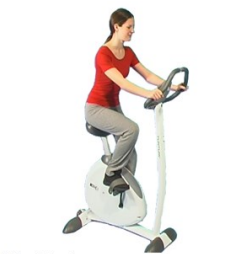
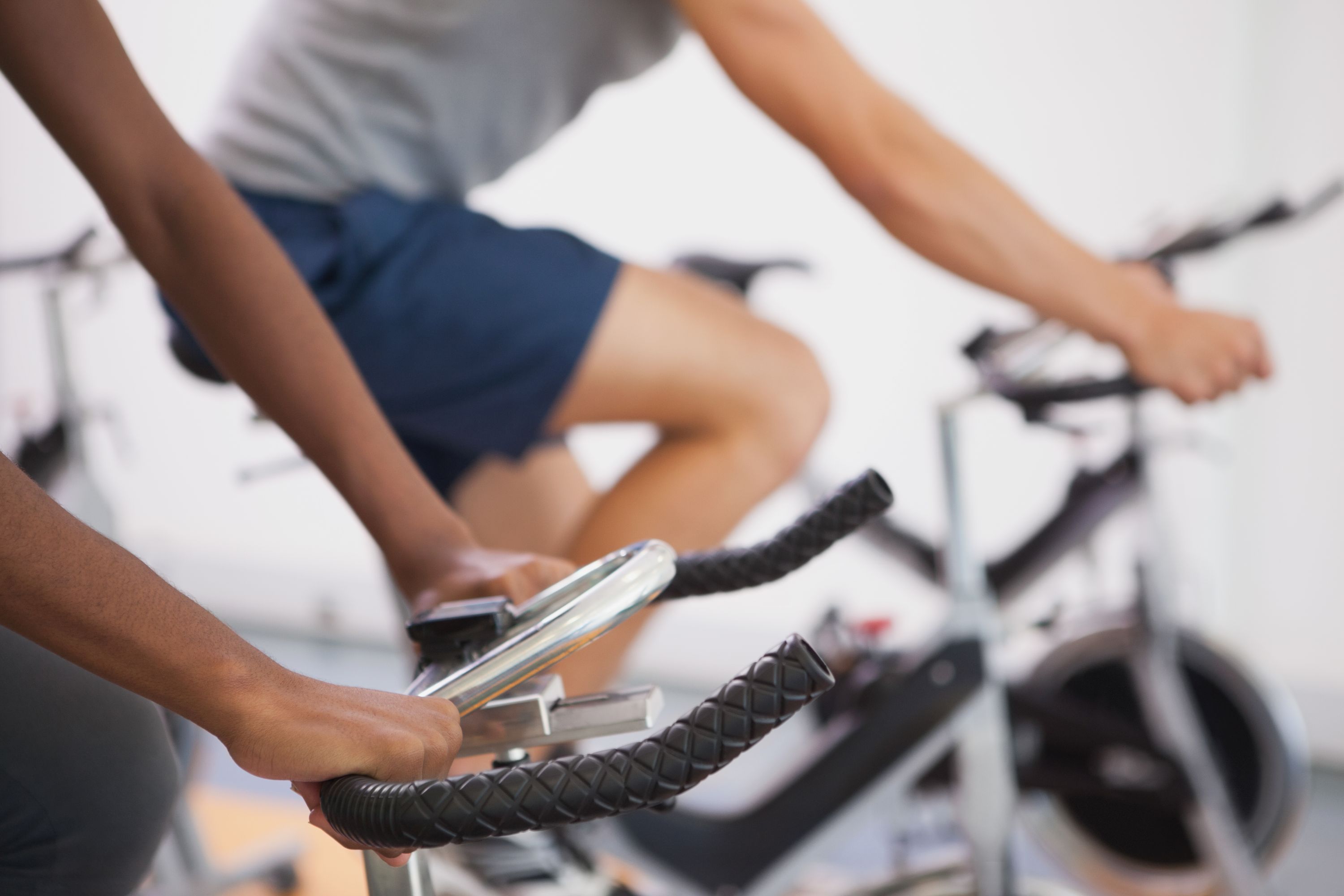
Start with a short duration and low load when cycling.
Progress gradually if you are able to.
Top tips
Read our top tips about hip pain exercises.
- Try and build your exercises into your everyday activities.
- You don’t have to do all the exercises in one go.
- Don’t feel you have to replicate the full movement of the exercise straight away. Use it as an initial guide.
- If one particular movement is painful, use this each week to evaluate your progress.
- It is normal for it to take 6 to 12 weeks before you see a good improvement in your pain, movement and strength.
- If your sleep is poor, try supporting your knees on a pillow if on your back and between the knees if you’re lying on your side.
- General exercise can really help your recovery so try to keep going with other activities you enjoy to help keep fit.
- Wear sensible, well-fitted shoes, such as trainers.
Need more help?
Consider self referring using the link below:
If you have a new injury or problem, please look at the self help information in our advice pages. We will often complete the same exercises and share information in clinic appointments.
If you still need some more help you can self refer into our service. Please note that the NHS is currently experiencing longer than normal waits, for more information visit our waiting times page.