
Carpal tunnel syndrome
Wrist exercises
Read below for advice and exercises to manage wrist pain.This guidance has been produced by the Dynamic Health physiotherapy service. It offers simple measures to help you manage your wrist problem safely. Often the right advice and exercises are all you need to improve the problem.
How much exercise should I do?
Exercise every other day
Allowing enough rest is important to let soft tissues recover and develop.
Choose 3 or 4 exercises
Choose exercises that are challenging but manageable.
Repeat the exercise
View each exercise below for information about how many repetitions.

Rest
Rest for up to 1 to 2 minutes between each set.
Once an exercise is easy, progress it
Increase the number of repetitions (aim for 10). Or hold the positions for longer or move to a more challenging exercise.

How much pain is too much pain?
Read below for advice and exercises to manage wrist pain.
Before exercising
Before exercising, rate your pain at the moment on a scale of 0 to 10, where 0 is no pain and 10 is the worst pain you can imagine.
A maximum pain level
A maximum pain level of 4/10 whilst exercising is fine as long as it eases within 45 minutes of the session and does not interfere with sleep or activities the next day.
If your pain increases
If your pain increases beyond this, simplify the exercise by reducing the range of movement or number of repetitions, or try an easier exercise.
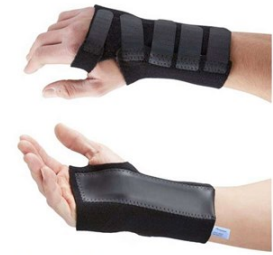
Use a wrist splint at night to sleep in. This can help reduce your morning symptoms.
Use for a minimum of 6 weeks.
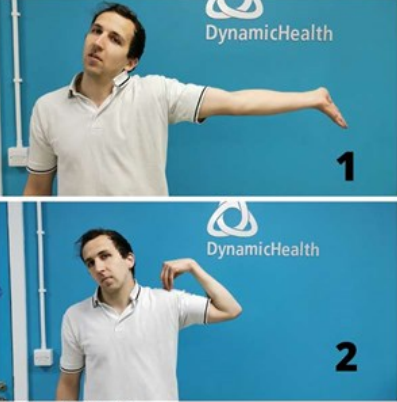
Nerves cannot be stretched like elastic, it is better to think of nerves as being like a piece of string. What you can do however is "slide" the nerves up and down your arm by altering where the tension is. This should relive any area where the nerve is becoming stuck and causing symptoms.
For this "slider" there are two positions that you will need to move between.
- Palm facing away from yourself with fingers pointing towards the floor. Your head should lean towards your arm.
- Curl your arm so that you are touching your shoulder. Lean your head away from your arm.
Alternate between stages 1 and 2. Repeat 20 to 30 times.
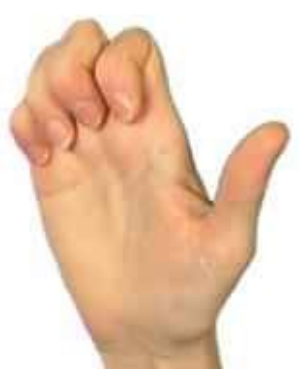
Try to touch your fingertips down to the pad at the base of your fingers.
You can complete these three finger flexion exercises together, going from the first to second to third exercise and then repeating this cycle.
If you are not able to complete these movements with every finger, consider helping the movement with your other hand.
Repeat 10 times for 3 sets.
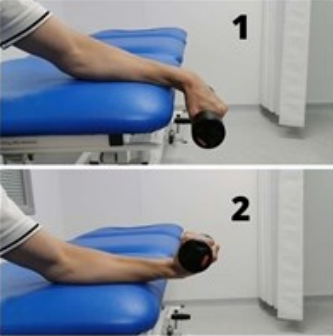
Using a dumbbell with your hand resting over a table, start with your palm facing down and your fingers pointing towards the floor (as shown in picture 1).
Raise your hand up so that your palm faces away from you (as shown in picture 2).
Slowly return to the position in picture 1.
Repeat 10 times for 3 sets.
Sit with your wrist over the edge of a table.
Bend the wrist down and gently assist this movement with your other hand. Hold for 15 seconds. Repeat 3 times.
Hold the fingers of the hand to be stretched.
Gently extend the wrist until you feel the stretching at the inside of the forearm. Keep your elbow straight.
Hold this stretch for around 15 seconds, then relax. Repeat 3 times.
Need more help?
Consider self referring using the link below:
If you have a new injury or problem, please look at the self help information in our advice pages. We will often complete the same exercises and share information in clinic appointments.
If you still need some more help you can self refer into our service. Please note that the NHS is currently experiencing longer than normal waits, for more information visit our waiting times page.
Click the link below for self-referal